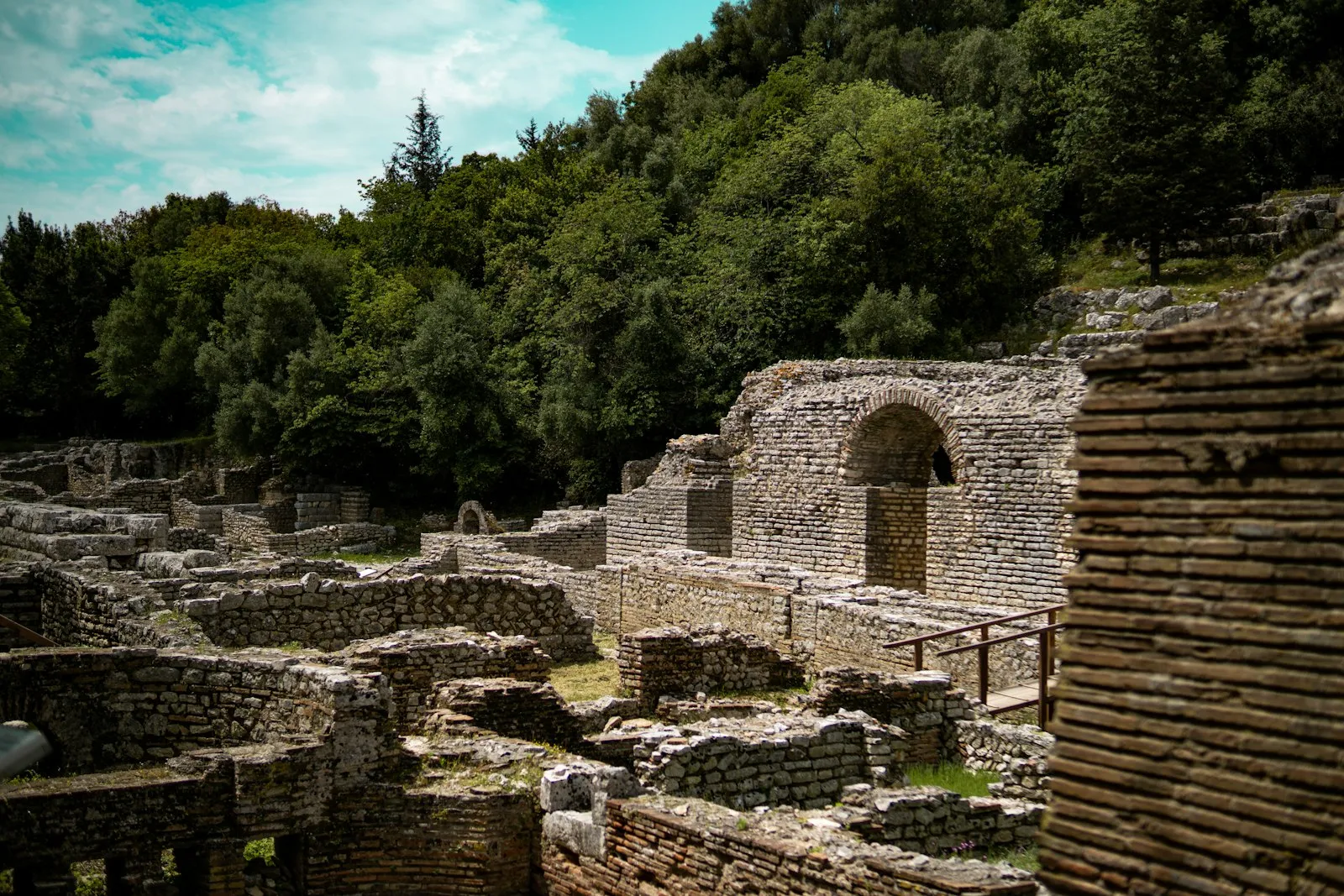
Butrint National Park protects the ruins of an ancient city at the southern tip of Albania, some 18 km by road south of Saranda and close to the Greek border. Inhabited for well over 2,000 years, it layers a Greek theatre, Roman baths, an early Christian baptistery and basilica, and Venetian and Ottoman fortifications on a wooded peninsula ringed by lagoon, and it has been a UNESCO World Heritage Site since 1992.
Allow two to three hours to walk the main circuit, and more if you want to linger in the museum and explore the quieter corners of the park. Here is what to see, how to get there and how to make the most of your visit.
A short history of Butrint
Butrint began as a settlement of the Chaonians, a Greek-speaking tribe of Epirus, on a hill above Lake Butrint. By the 4th century BC it had a theatre, a sanctuary of Asclepius, the god of healing, and an agora. Roman writers gave it a grander origin: in Virgil’s Aeneid the city is founded by Helenus, son of King Priam, after the fall of Troy, and Aeneas himself stops here on his travels.
Julius Caesar named Buthrotum a colony for his veterans in 44 BC, and after the battle of Actium Augustus revived the plan, adding an aqueduct, baths and a forum. In late antiquity the city became the seat of a bishop, which brought the baptistery and basilica. It later passed between Byzantines, Angevins and Venetians, was abandoned for a small Venetian fort on the channel in the late 16th century, and fell to Ali Pasha of Tepelena in 1798.
Modern excavations began in 1928 under the Italian archaeologist Luigi Maria Ugolini. Butrint joined the UNESCO list in 1992, was placed on the List of World Heritage in Danger after looting in 1997, and was removed from it in 2005. The national park was created in 2000, and the lagoon became a Ramsar wetland of international importance in 2003.
What to see on the main circuit
The theatre and the Sanctuary of Asclepius
Set below the acropolis and facing the Vivari Channel, the Greek theatre was later enlarged by the Romans. Its stones carry many inscriptions recording the freeing of slaves, and the sanctuary of Asclepius stood right beside it.
The baptistery
Built in the 6th century, Butrint’s baptistery is one of the largest early Christian buildings of its kind and is famous for its large, complex mosaic floor. To protect it, the mosaic is normally kept covered with sand and revealed only occasionally, so do not be surprised to find it hidden.
The Great Basilica
The basilica was built in the first half of the 6th century and rebuilt in 1267 under Charles of Anjou. Its walls and arches still give a strong sense of the original church.
The Lion Gate and the city walls
The outer city walls, built in the 4th century BC, had several gates. The Lion Gate takes its name from a carved relief of a lion bringing down a bull, and its passage is so narrow that only a few people could enter at once. Nearby, the Scaean Gate was named by Ugolini after the gate of Troy in Homer’s Iliad.
The acropolis and museum
The path climbs to the acropolis, where a Venetian castle, restored by Ugolini in the 1930s, houses the site museum with finds from the excavations. The views over Lake Butrint and the channel from the top are among the best in the park.
Beyond the ruins: channel, castles and wildlife
The Vivari Channel links Lake Butrint with the Straits of Corfu, and its water flows in and out with the tides, which is why the lagoon is part salt and part fresh and dotted with mussel farms. A small pontoon ferry near the park entrance crosses the channel. On the far bank stands the Venetian Triangular Castle, built to guard the valuable fish traps, while Ali Pasha’s castle sits near the channel mouth.
The park covers far more than the archaeological site: some 94 km² of hills, wetlands, reed beds and islands, including the islands off Ksamil. More than 240 bird species have been recorded here, from egrets and cormorants on the lagoon to golden eagles overhead, and early morning is the best time to see them.
How to get to Butrint
Butrint lies at the end of the coast road from Saranda, which runs south past Ksamil. Local buses link Saranda, Ksamil and Butrint throughout the day, taxis are easy to find in Saranda, and many visitors combine the site with an organised tour of the south. Day-trippers from Corfu can take a ferry to Saranda and continue by road. In high season the road gets congested, especially around sunset, so leave extra time.
Tips for your visit
- Arrive early or late in the day in summer to avoid the heat and the busiest tour-group hours; much of the site is shaded by woodland, but open areas get hot.
- Wear comfortable shoes: paths are uneven, with steps up to the acropolis.
- Bring water, sun protection and insect repellent for the waterside areas.
- After heavy rain, low-lying parts of the site such as the theatre and the forum can be partly under water.
- Check the current ticket price and opening hours before you go, and keep your ticket.
- A guide or a good guidebook makes the many layers far easier to understand.
Spring and autumn are the most pleasant seasons: the woods are green, the light is soft and the crowds are thinner. Combine Butrint with an afternoon on the beaches of Ksamil or a morning at the Blue Eye spring, and read our traveller’s guide to Ksamil for ideas. For Albania’s other World Heritage sites, see Albania’s UNESCO gems.
Frequently asked questions
How long do you need at Butrint?
Two to three hours is enough to walk the main circuit, taking in the theatre, baptistery, basilica, Lion Gate and the acropolis with its museum. Keen history lovers and birdwatchers could easily spend half a day, adding a walk along the channel and a closer look at the walls. Combining Butrint with Ksamil or Saranda makes for a relaxed full day.
Why is Butrint a UNESCO World Heritage Site?
Butrint was listed in 1992 because few sites show so clearly how a Mediterranean city evolved over more than two millennia. Greek, Roman, Byzantine, Venetian and Ottoman remains sit side by side in a remarkably well-preserved natural setting of woodland, lagoon and marsh. Today the site is also protected as a national park and a Ramsar wetland.
Can you visit Butrint as a day trip from Corfu?
Yes. Ferries and faster boats cross between Corfu and Saranda, and Butrint is a short drive or bus ride south of the port, so a day trip is very popular. Check current timetables and border requirements before you travel, carry your passport, and remember that Albania and Greece are in different time zones.
When is the best time of day to visit Butrint?
Early morning is ideal: the light is beautiful, temperatures are lower, birdlife on the lagoon is at its most active and you will beat most tour groups. Late afternoon is a good alternative in summer, when the heat eases and the crowds thin. Whatever the time, check the current opening hours before setting out.
Is Butrint suitable for children?
Generally yes. Children usually enjoy exploring the theatre, the walls and the castle on the acropolis, and the woodland paths offer welcome shade. The terrain is uneven, with steps and some slippery stones, so keep an eye on little ones near the water and the ruins. Bring snacks, water and sun hats in summer.
See Butrint with a guide on our Tour of South Albania in 4 Days, which pairs the ruins with the Ksamil islands, Gjirokastër, Saranda and Berat, or on the East Balkans tour from Albania to Romania, which visits Butrint and Ksamil early in the route.