
Understanding the Albanian Lek Currency
Imagine sitting at a seaside café in Saranda where the waiter asks for “ten thousand” for a simple coffee. Before checking your wallet in panic, rest assured you haven’t been overcharged; you have simply encountered the most common verbal quirk of the Albanian currency.
While much of the continent adopted the Euro, this Balkan nation retained its unique money, officially tracking under the ISO 4217 ALL code. In practice, shopkeepers usually abbreviate prices with a simple ‘L’ symbol, a historic nod that distinguishes their cash from foreign tender.
Navigating this cash-first society means recognizing that locals often speak in “Old Lek,” verbally adding a zero that doesn’t exist on the banknote. Decoding this mathematical ghost is essential to paying the real price without confusion.
Why is it Called the Lek? The Story of Alexander the Great and Your First Handful of Coins
While the name “Lek” sounds simple, it carries heavy history, derived from “Leka i Madh”—the Albanian name for Alexander the Great. For modern travelers, however, the most important connection isn’t ancient history but simple math: the 100 Lek coin is roughly equivalent to 1 Euro (or slightly more than $1 USD). This 100-to-1 ratio is your best mental anchor for quick price conversions on the go.
Rummaging through your pockets, you will find a hierarchy of metal coins ranging from practically worthless to daily essentials:
- 1 and 5 Lek: Small coins rarely seen in circulation.
- 10, 20, and 50 Lek: Standard change used for small adjustments.
- 100 Lek: A distinct bi-color coin featuring Queen Teuta, an ancient Illyrian ruler.
Don’t be alarmed if a shopkeeper waves away a tiny 1 or 5 Lek difference in your bill. Because the smallest denominations have very little purchasing power, cash transactions are often casually rounded to the nearest ten to keep lines moving.
A Visual Pocket Guide: Identifying Albanian Banknotes by Color, King, and Poet
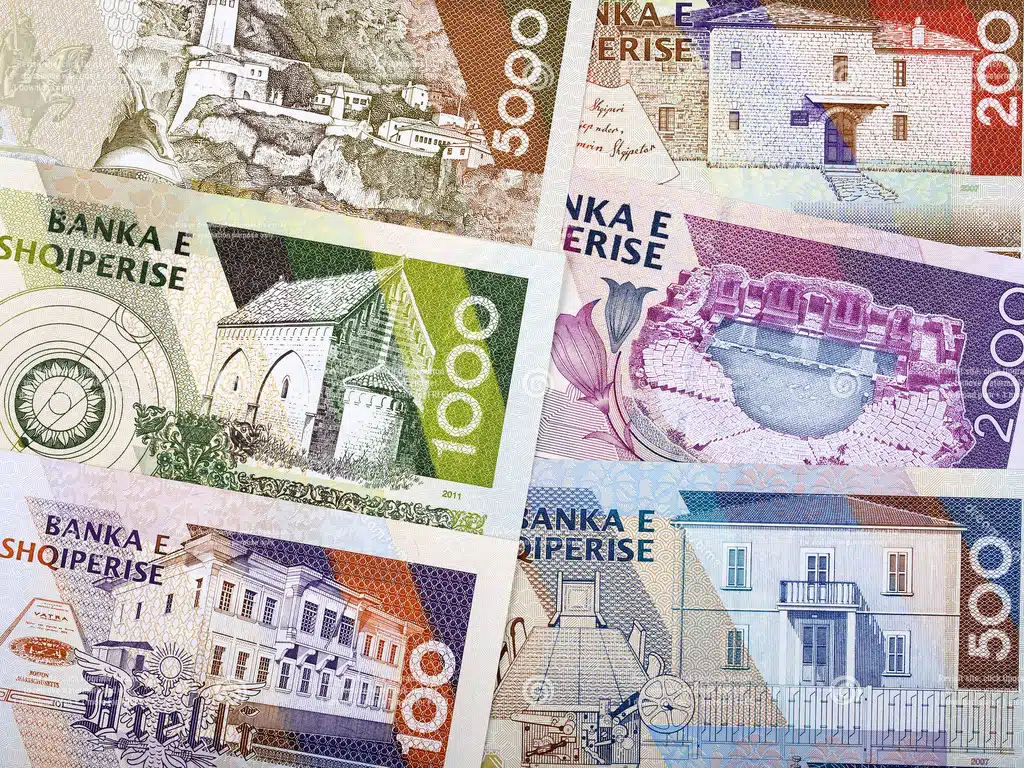
While coins handle small change, your daily spending will mostly involve colorful banknotes that tell a story through their design. The Bank of Albania has recently modernized the most frequently used Albanian money, upgrading the 200 and 5,000 Lek notes—and introducing a polymer 200 Lek note—to durable plastic. This material feels sleeker than standard paper and resists tears or moisture, a practical benefit if your cash accidentally takes a swim during a beach day in Saranda.
Your wallet will likely fill up with green 1,000 Lek bills, the true workhorse of the economy. Worth roughly ten Euros, a single note easily covers a casual lunch or a taxi ride. On the lower end, you will find the brown 200 Lek note featuring the national poet Naim Frashëri. Its distinct see-through window makes it instantly recognizable, ensuring you don’t mistake it for a higher value bill during a quick transaction.
Stepping up in value, the purple 2,000 Lek note is perhaps the most striking design you will encounter. It honors King Gentius, the last ruler of the Illyrian state, blending ancient history with modern security features. If you tilt the note under the light, the holographic strip changes color, providing a quick way to verify authenticity without needing special tools.
Learning these colors helps you grab the right bill quickly, but visual identification is only half the battle. Once you start speaking with locals, you will inevitably encounter a confusing verbal habit where the price on the tag and the price spoken aloud differ by a factor of ten.
The ‘Ghost Zero’ Mystery: Why a 100 Lek Coffee Costs ‘One Thousand’ in Conversation
Imagine ordering an espresso priced at 100 Lek, only to hear the barista ask for “one thousand.” This isn’t hyper-inflation; it is a cultural holdover from 1965 when the government removed a zero from the currency. While the official notes changed immediately to “New Lek,” the public never removed the zero from their speech. Decades later, this creates a massive discrepancy between the price you see printed on a menu and the total you hear spoken aloud.
Navigating this requires a simple mental filter: if a verbal price sounds impossibly high, simply divide by ten. A taxi driver might request “seven thousand” for a ride that clearly reads 700 on the meter. Conversely, if you hand over a 5,000 Lek note, a shopkeeper might count your change starting from “fifty thousand.” You haven’t struck it rich; you are simply hearing the “ghost zero” that locals refuse to give up.
To keep your budget on track, use this quick translation guide for common expenses:
- Espresso: Written 80 L (New) = Spoken “800” (Old)
- Bottle of Water: Written 50 L (New) = Spoken “500” (Old)
- Restaurant Meal: Written 1,500 L (New) = Spoken “15,000” (Old)
Misunderstandings here are rarely malicious, even if they feel alarming at first. While travelers are right to prioritize avoiding currency exchange scams abroad, this specific scenario is usually just the dynamic between the old and new valuation in action. Always trust the written menu or register display, which legally must show the payable New Lek value.
Cash is King in Tirana: Navigating ATMs, Tipping Customs, and the Euro Dilemma
While credit cards work in high-end hotels and supermarkets, most daily life in Albania runs on physical cash. You will frequently encounter card machines that are “broken” or non-existent at family-run restaurants, so carrying Lek is non-negotiable. When withdrawing funds, watch the ATM screen closely for an “access fee” warning; many commercial banks charge 600–800 Lek ($6–$9) per withdrawal. To save money, look for banks offering free withdrawals for foreign cards or withdraw larger amounts at once to dilute the fee.
Vendors frequently accept Euros, but relying on foreign currency triggers a hidden “convenience tax.” A shopkeeper will typically apply a simplified exchange rate—often rounding 1 Euro to 100 Lek regardless of the market value—which effectively costs you 5–10% more on every purchase. To maximize your purchasing power and respect local commerce, politely decline the Euro offer and pay strictly in Lek.
Once the bill arrives, navigating local tipping customs is relaxed but specific. Service charges are rarely included, so follow these simple rules to blend in:
- Cafes: Simply round up the total (e.g., leave 200 Lek for a 180 Lek macchiato).
- Dining: Leave a standard 10% cash tip directly on the table, as card machines rarely have a tip function.
If you arrived with cash instead of cards, your next priority is finding a fair trade at a local exchange.
Where to Swap Your Euros: Finding the Best Rates and Avoiding ‘Kantier’ Scams
Avoid airport kiosks immediately upon landing; their rates usually include high margins that eat into your travel budget. Instead, look for signs reading “Këmbim Valutor” in the city center. These independent, licensed storefronts are ubiquitous and offer competitive rates that banks rarely match, making them the standard method for exchanging money safely.
Interpreting the electronic board requires checking the gap between the “Buy” (Bli) and “Sell” (Shit) columns. A trustworthy agency typically keeps this spread tight—often less than 1 Lek difference for Euros—which signals a fair deal without hidden fees. Always confirm “No Commission” verbally before handing over cash to ensure the shop is adhering to official exchange rates rather than adding surprise surcharges.
Since global markets influence local value, the best time to buy currency is during standard weekday business hours. Agencies frequently widen the gap between buy and sell prices on weekends to protect themselves against market changes while they are closed, which results in a worse deal for you. With your wallet now full of fair-value notes, you are ready to tackle the specific logistics of your first 24 hours.
Your 5-Minute Currency Action Plan
You are no longer a tourist fumbling with foreign bills; you now possess the savvy to navigate transactions like a local. To solidify your grasp on the currency, start by withdrawing cash at a city ATM and mentally dropping the “ghost zero” whenever a vendor quotes a price that sounds sky-high. This simple adjustment instantly separates the real cost from the linguistic quirk, ensuring you never overpay out of confusion.
For effortless spending, keep the “100 Lek equals roughly 1 Euro” rule ready for quick conversions. Tracking the value doesn’t require complex math, just this reliable anchor. You can now confidently enjoy the history in your wallet, knowing exactly what your money is worth—even when the locals playfully count in millions.
Frequently Asked Questions
Question: Why does a 100 Lek coffee get quoted as “one thousand” at the counter? Short answer: Albania still speaks in “Old Lek,” a habit dating to 1965 when a zero was removed from the currency. Prices are printed and paid in New Lek, but many people still add a verbal “ghost zero.” To decode it, just divide the spoken price by 10 and trust the written menu or register display, which must show the legal New Lek amount.
Question: What’s the quickest way to convert Lek to Euros (or USD) in my head? Short answer: Use the 100-to-1 rule of thumb: 100 Lek ≈ 1 Euro (and slightly more than $1 USD). That makes 1,000 Lek ≈ €10, 200 Lek ≈ €2, and so on. This simple anchor lets you sanity-check prices instantly, even when someone quotes in Old Lek.
Question: Which coins and banknotes will I actually use, and how do I recognize them fast? Short answer: Expect coins mainly for change: 10, 20, and 50 Lek are common; 1 and 5 Lek are rarely used; the 100 Lek is a bi‑color coin with Queen Teuta. Small differences are often rounded to the nearest ten. For notes, you’ll see lots of green 1,000 Lek bills (everyday workhorse), a brown 200 Lek polymer note with a clear window featuring poet Naim Frashëri, and a striking purple 2,000 Lek note honoring King Gentius with a color‑shifting holographic strip for quick authenticity checks. Albania’s currency appears as “L” in shops and has the ISO 4217 code ALL.
Question: Should I pay in Euros in Albania? Short answer: It’s possible but usually costs more. Many vendors round 1 Euro to 100 Lek regardless of the market rate, adding a 5–10% “convenience tax.” To get fair value and support local norms, pay in Lek.
Question: How do I minimize fees when withdrawing or exchanging money? Short answer: At ATMs, watch for access fees of about 600–800 Lek per withdrawal; either find banks that don’t charge foreign cards or withdraw larger amounts to dilute the fee. For cash exchange, skip airport kiosks and use city “Këmbim Valutor” bureaus. Look for a tight Euro spread (Buy/Sell gap often under 1 Lek), confirm “No Commission,” and exchange on weekdays—weekend spreads are often worse. Tipping is simple: round up at cafes and leave about 10% in cash at sit‑down restaurants.
Q&A
Question: What is the “ghost zero,” and how does it change what I actually pay? Short answer: It’s a spoken habit where locals quote prices in “Old Lek,” adding a zero that isn’t on the banknote. The currency dropped a zero in 1965, but many people still speak as if it’s there. If you hear “one thousand” for a 100 Lek coffee, just divide the spoken price by 10 and pay the New Lek amount shown on the menu or register—the written price is the legal one.
Question: How can I identify Albanian banknotes quickly and spot fakes on the go? Short answer: Use color and featured figures as shortcuts. The green 1,000 Lek is the everyday workhorse; the brown 200 Lek (polymer) shows poet Naim Frashëri and has a clear window; the purple 2,000 Lek honors King Gentius and has a color‑shifting holographic strip that changes under light. The 200 and 5,000 Lek notes have been modernized, with the 200 now in durable polymer that resists tears and moisture—handy for beach days. If in doubt, tilt the 2,000 for the hologram shift or check the 200’s see‑through window.
Question: Do small coins matter, and is rounding normal in cash payments? Short answer: Expect 10, 20, and 50 Lek coins as standard change; 1 and 5 Lek are rarely used. The 100 Lek bi‑color coin (Queen Teuta) is common and practical. Because the smallest denominations have little buying power, vendors often round to the nearest 10 Lek—don’t be surprised if tiny differences are waved away.
Question: What’s the most cost‑efficient way to get and spend Lek? Short answer: Withdraw cash but watch ATM screens for access fees (often 600–800 Lek). Either find banks that don’t charge foreign cards or take out larger amounts to dilute the fee. Skip airport exchange kiosks; instead, use city “Këmbim Valutor” bureaus, look for a tight Euro spread (Buy vs. Sell often under 1 Lek), confirm “No Commission,” and exchange on weekdays since weekend spreads are usually worse. Spend in Lek, not Euros—many vendors round €1 to 100 Lek, which effectively adds a 5–10% premium to your purchase.
Question: How should I tip, and can I add it to a card payment? Short answer: Albania is cash‑forward and card machines often lack a tip function. Service charges are rarely included, so round up at cafes (e.g., pay 200 Lek on a 180 Lek bill) and leave about 10% in cash at sit‑down restaurants. Paying and tipping in Lek is the smoothest way to match local custom.